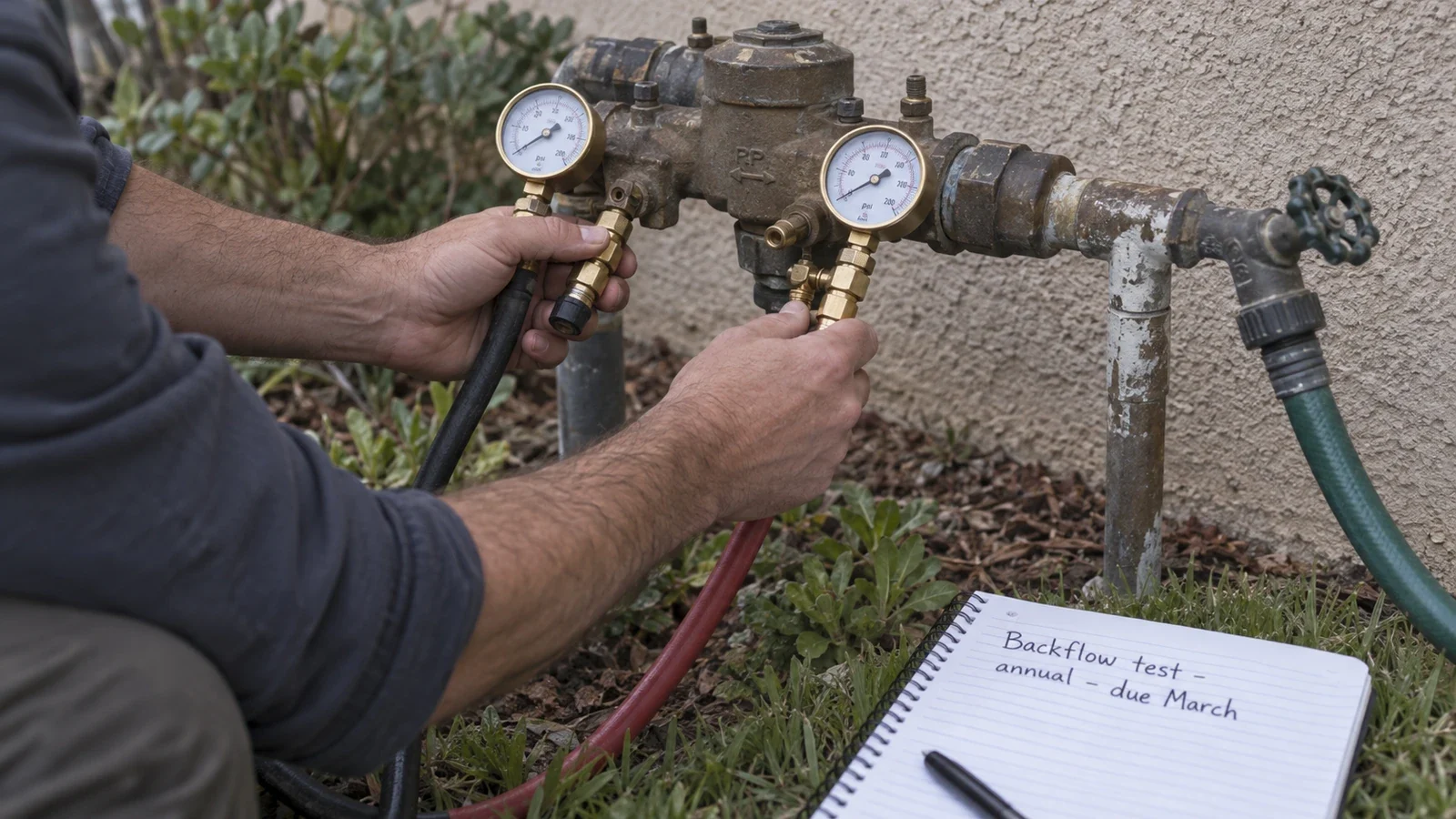
If your home has an underground lawn irrigation system, it almost certainly has a backflow preventer installed where the system connects to your water supply — and in most cities and water districts, that device has to be tested every year by a certified tester, not just installed once and forgotten.
Why this exists at all
A backflow preventer stops water from flowing backward from your irrigation system into the public drinking water supply. Irrigation lines sit in soil, pick up fertilizer, pesticide residue, and standing water, and if pressure in the main line drops — a water main break, heavy simultaneous demand, firefighting nearby — that contaminated water can siphon backward into the pipes that supply drinking water to your house and your neighbors' houses. This is a genuine public health control, not a bureaucratic add-on, which is why testing is required by code rather than left to homeowner discretion.
Who has to test it, and how often
Most jurisdictions require backflow assemblies to be tested annually by a state-certified backflow prevention assembly tester (BPAT), and a growing number require the test result to be filed directly with the water utility, not just kept on file at home. Requirements do vary: some municipalities classify a residential irrigation backflow device as low-hazard and only require testing once every several years, so the exact interval depends on your specific city or water district's program, not a single national standard.
| Step | What happens |
|---|---|
| Permit at install | Most jurisdictions require a permit before an irrigation backflow device is installed, tied to the property's water account. |
| Annual (or district-set) test | A certified tester checks the device under pressure for proper check-valve and relief-valve function. |
| Result filing | Many utilities require the tester or homeowner to submit the passing result directly to the water department by a set deadline. |
| Non-compliance | Repeated failure to test or file results is grounds for water service restriction or termination in many municipal codes. |
Who can actually perform the test
Only a certified tester — credentialed through a state or local backflow-testing certification program, sometimes an ASSE-licensed tester specifically — can perform a test result your water utility will accept. A homeowner or general handyman cannot self-certify this test even if they own the tools, because the point of the requirement is an independent, credentialed check, not just a working device.
What happens if you skip it
- Late or missing test results can trigger a notice, then escalate to a fine in many municipal water codes.
- Some utilities will restrict or shut off water service entirely for continued non-compliance, which affects your whole house, not just the irrigation zone.
- A failed device that goes unrepaired is a genuine cross-connection risk to your own household's drinking water, independent of the compliance paperwork.
- If you're selling the home, an unresolved backflow-testing violation on file with the water utility can surface during closing and needs to be cleared first.
How to find your actual local requirement
Search your city or water district's name plus "backflow testing" or "cross-connection control program" — most utilities publish the exact interval, the list of certified local testers, and the filing deadline directly. Do not assume your neighbor's schedule or a general internet answer matches your specific municipality; testing frequency, filing method, and enforcement all vary by local program.
What a typical test actually checks
A certified tester connects gauges to the device's test cocks and checks that the check valves hold pressure properly and that the relief valve opens at the correct differential. The test itself usually takes 15 to 30 minutes and requires temporarily shutting down the irrigation zone. Keep a copy of every passing result even if your utility also files it, since you may need to produce your own testing history at a home sale or if a filing gets lost on the utility's side.
How much a test and a replacement actually cost
A routine annual backflow test typically runs in the range of most standard plumbing service call fees — modest compared to the cost of a water-restriction violation or the cost of replacing a device that fails during testing. If the device itself fails (a stuck check valve or a relief valve that won't reseat), replacement of a residential-grade irrigation backflow preventer is a relatively small parts cost, but it does require the same certified tester or a licensed plumber to reinstall and re-test before the utility will accept the result.
What a certified tester actually looks for beyond pass/fail
Beyond the pass/fail result your utility files, a good tester will flag early warning signs that don't yet cause an outright failure: a check valve that holds but is slow to reseat, minor weeping at a test cock, or corrosion starting to build on the housing in a way that suggests the device is nearing the end of its service life. Ask for these notes even when the device passes — it turns an annual compliance chore into an early-warning system for a repair you can schedule on your own timeline instead of during an emergency shutoff.
Does a backflow preventer for irrigation need testing even if I rarely use my sprinklers?
Yes. The testing requirement is tied to the device being connected to the potable water supply, not to how often the irrigation system runs. An idle system can actually be more prone to a stuck or corroded valve than one used regularly.
Can I test my own backflow preventer if I bought the gauge kit?
No. Utilities require the test be performed and certified by a state- or locally-certified tester, often ASSE-licensed specifically, because the result has to be independently verifiable and filed by someone accountable for its accuracy, not simply self-reported by the homeowner using a borrowed or purchased gauge kit.
What happens at closing if a backflow test is overdue?
Many water utilities will not transfer a water account, or will flag the property, until an overdue test is completed and filed — treat it the same as an unresolved utility bill when preparing to sell.
Freeze protection and the testing schedule interact
In cold climates, the backflow preventer usually sits above ground near where the irrigation line enters the yard, which means it also needs winterizing before hard freezes — draining or blowing out the line, and sometimes insulating or removing the device entirely for winter. Scheduling your annual test for early spring, right after you reinstall or reactivate the device for the season, avoids the common mistake of testing in fall and then having the device sit through a freeze-thaw cycle untested before the next irrigation season actually starts.
If you're buying a home with an existing irrigation system, ask the seller for the backflow device's test history directly rather than assuming a working sprinkler system implies a compliant device — the two are unrelated. A system can water your lawn perfectly while its backflow preventer sits years overdue on testing, since the device only activates under an abnormal pressure event and gives no everyday symptom of neglect. Many home inspectors do not check backflow-testing compliance as part of a standard inspection, so this is worth confirming separately with the water utility before closing.
Keep the tester's business card or certification number with your annual test paperwork — if a utility ever disputes whether a filed result came from a properly certified tester, having that credential on hand resolves the question immediately instead of leaving you to track down a tester you used a year earlier.