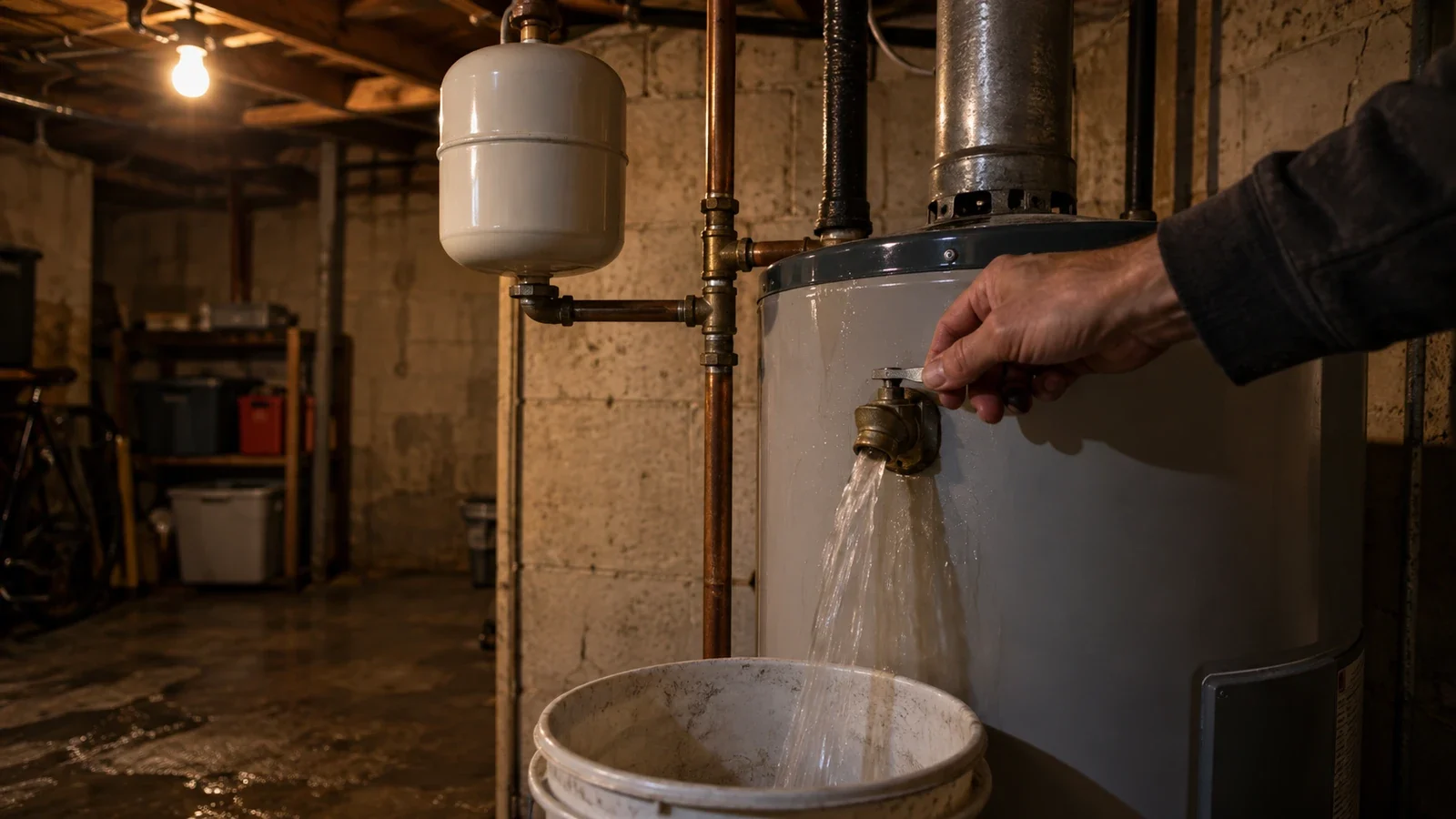
Every storage water heater is required by plumbing code to have a temperature and pressure (T&P) relief valve, and most homes on a closed plumbing system (one with a check valve or pressure-reducing valve at the meter) also need a thermal expansion tank. Both are safety and system-protection devices that quietly do nothing for years — until the day they need to work, at which point a neglected one may not.
What the T&P relief valve actually does
The valve is a spring-loaded safety device mounted on the water heater tank, set to open automatically if either temperature or pressure inside the tank exceeds a preset threshold — typically around 210°F or 150 psi on most residential units, though the exact rating depends on the specific valve and local code. Without it, a malfunctioning thermostat or a closed system with nowhere for expanding hot water to go could, in the worst case, build enough pressure to rupture the tank. This is one of the few pieces of home equipment where "it's never gone off, so it must be fine" is exactly backwards — a valve that's never been tested may be stuck closed by mineral buildup and simply unable to do its job when it's actually needed.
What an expansion tank does, and why it matters more on closed systems
An expansion tank does not relieve pressure directly — it absorbs the small volume increase that happens every time water heats up and expands, giving that extra volume somewhere to go inside a pre-charged air cushion instead of building pressure in a closed system with no other outlet. Many municipal water systems install check valves or pressure-reducing valves at the meter specifically to prevent backflow, which has the side effect of turning your home's plumbing into a closed system — and a closed system without an expansion tank will send its thermal expansion straight into repeatedly triggering the T&P relief valve instead.
How to check the T&P valve
- Locate the valve and its discharge pipe, usually on the top or side of the tank with a pipe running down toward the floor.
- With a bucket or drain nearby, lift the valve's test lever partway and let it snap back — you should hear or see a burst of water discharge through the pipe.
- If nothing discharges, or if it discharges but then keeps dripping continuously afterward, the valve is likely faulty and needs replacement, not just re-testing.
- Inspect the valve body and discharge pipe for mineral scale, corrosion, or physical damage while you're there — any of these can prevent proper operation even if the lever test seems to work.
- If the valve won't move, is corroded shut, or you're not comfortable with the water discharge, call a plumber rather than forcing it — a valve that shears off in a stuck position can itself cause a leak.
How to check an expansion tank
Tap the tank: it should sound different on the top half (air-filled) than the bottom half (water-filled). If it sounds the same throughout, or feels waterlogged, the internal bladder has likely failed and the tank needs replacement — a failed expansion tank effectively becomes dead weight and stops doing its job, which shows up as more frequent T&P valve discharges or unusually high water pressure spikes when hot water is used.
A relief valve that drips constantly is not normal
Occasional discharge during or right after heavy hot water use can be normal on a closed system, especially without a properly sized expansion tank. But a valve that drips continuously, regardless of usage, usually means either the valve itself has failed, water pressure is too high, or the expansion tank has failed or was never installed. Don't just tighten or cap a leaking T&P valve to stop the drip — that removes the one safety device standing between a malfunction and a tank failure.
A reasonable check schedule
Test the T&P valve at least once a year, and tap-check the expansion tank at the same time — pairing both checks with an existing annual task like water heater flushing makes it easier to actually remember. Replace the T&P valve immediately if it fails to discharge, discharges and won't reseat, or shows visible corrosion, regardless of the water heater's own age.
How local code and water pressure interact
High incoming municipal water pressure — above roughly 80 psi — is itself a common root cause of chronic T&P valve discharge and premature expansion tank failure, independent of any device defect. If your relief valve keeps needing attention despite passing its own inspection, have your static water pressure tested at an outdoor spigot; a pressure-reducing valve set too high, or one that has drifted out of adjustment, is a frequent hidden cause that no amount of relief-valve or expansion-tank maintenance alone will fully solve.
Expansion tank pre-charge needs periodic checking too
An expansion tank arrives pre-charged with air at a specific pressure, meant to roughly match your home's static water pressure. Over years, that air charge can slowly leak down even without a bladder failure, which reduces the tank's usable capacity to absorb thermal expansion and leads to more frequent relief-valve activity well before the tank fails completely. Checking and, if needed, topping up the air charge at the tank's Schrader valve (with the tank isolated and drained of water first) is routine maintenance a plumber can do quickly during a water heater service visit.
How long does a T&P relief valve typically last before replacement?
There's no fixed universal lifespan — mineral content in your water, water pressure, and how often it's tested all affect longevity. Many plumbers recommend replacing the valve proactively every several years regardless of test results, especially in hard-water areas where scale buildup is faster.
Can I install an expansion tank myself?
It's a straightforward sweat or push-fit connection for someone comfortable with basic plumbing, but sizing it correctly for your water heater's tank capacity and your system's static pressure matters, and a wrong-sized tank won't fully solve expansion problems. Many homeowners have a plumber size and install it during an unrelated water heater service call.
Is a leaking T&P valve always the valve's fault?
No — a valve that discharges frequently is very often responding correctly to a real overpressure condition caused by high municipal pressure or a missing/failed expansion tank, rather than being defective itself. Diagnose the system before replacing just the valve.
Tankless water heaters have a different but related requirement
Tankless units don't store a large volume of hot water the way tank units do, so their relief-valve and expansion needs differ — many tankless systems still require a pressure relief valve at the unit and may still need an expansion tank on a closed system, but the sizing and code requirements are manufacturer- and jurisdiction-specific rather than following the same standard tank-heater rule of thumb. If you have a tankless system, check the manufacturer's installation manual directly rather than assuming the tank-heater guidance above transfers over unchanged.
When replacing a water heater, this is also the moment to confirm the expansion tank is sized correctly for the new unit rather than simply reusing the old tank — a larger-capacity water heater generates more thermal expansion volume, and an expansion tank sized for a smaller previous unit may be undersized for the replacement. Ask your plumber to confirm the expansion tank's sizing as part of any water heater replacement, not just its physical condition, since an old tank that still holds pressure can still be the wrong size for a new, larger heater.