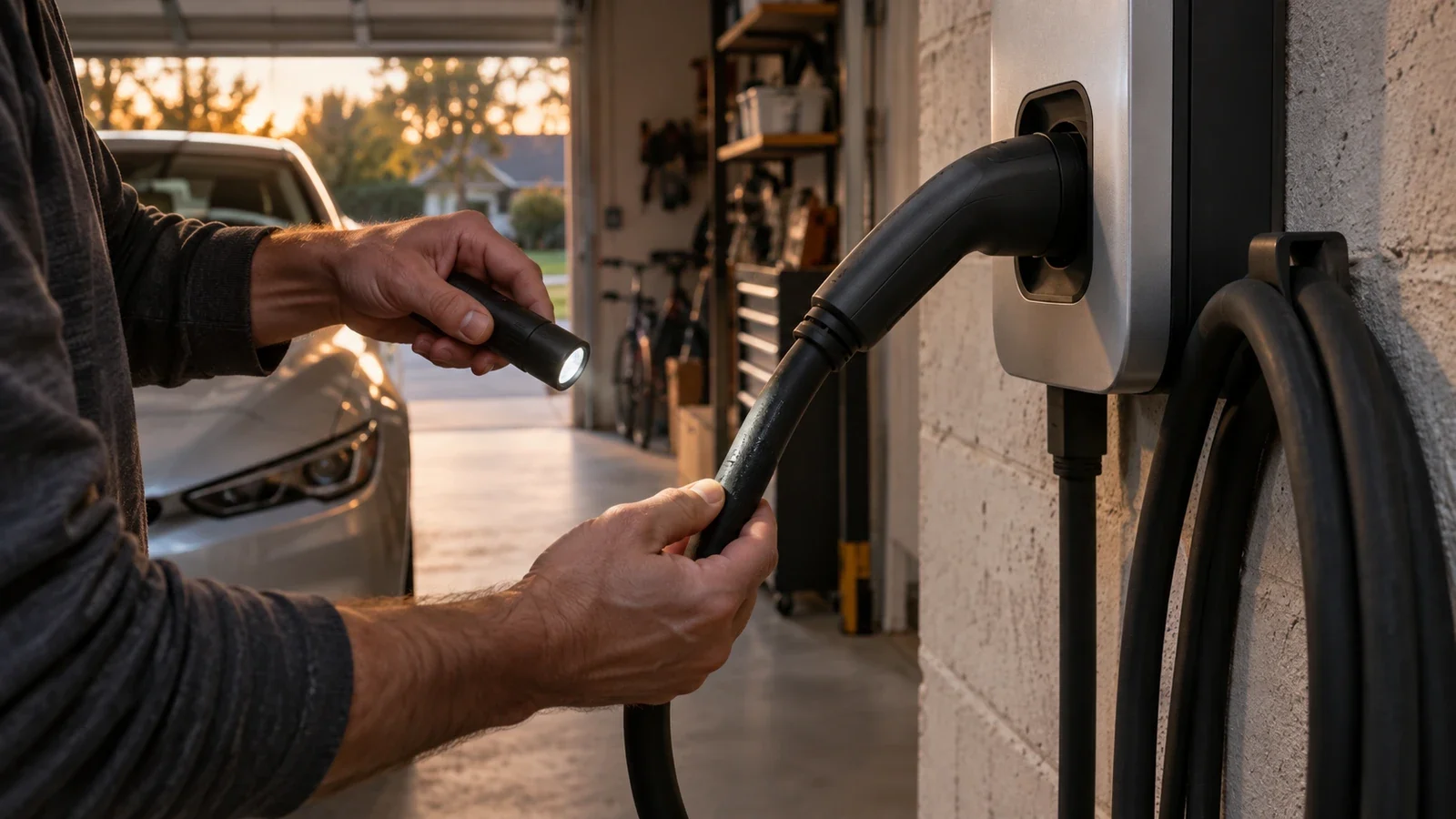
A Level 2 home EV charger is installed as a dedicated 240-volt circuit under NEC Article 625, with the breaker and cable rated for at least 125% of the charger's continuous output. That's a real, permanent electrical installation running at meaningful current for hours at a stretch, several times a week, in most households — which puts it closer to your electrical panel or your HVAC disconnect in maintenance importance than to a small kitchen appliance.
There's no single universal maintenance interval — check the manufacturer's manual
Unlike a water heater or an HVAC system, Level 2 home chargers don't have a widely standardized service interval published by code, because the National Electrical Code governs the installation itself, not an ongoing maintenance schedule for the unit. The specific charger manufacturer's documentation is the actual source for recommended inspection intervals, firmware updates, and any moving-part service — treat the general guidance below as a baseline homeowner check, not a replacement for what your specific charger's manual says.
What to visually check every few months
- The charging cable's full length for cuts, abrasion, or exposed conductors, especially near the connector and near where it enters the charger housing.
- The connector (the plug end that goes into the car) for cracked plastic, bent or discolored pins, or a loose fit when connecting to the vehicle.
- The wall-mounted unit's housing for cracks, water intrusion signs, or insect nesting if it's mounted outdoors or in a garage.
- The accessible disconnect required by code — confirm it's not blocked by stored items and that it still operates freely.
- Any status lights or the charger's app, if it has one, for recurring fault codes rather than a single one-off error.
Why the disconnect and breaker matter as much as the charger itself
Code requires an accessible disconnecting means specifically so power can be cut quickly in an emergency or for service — which only works if it's actually reachable and not buried behind storage. Periodically confirm the dedicated breaker feeding the charger isn't showing signs of overheating (discoloration, a breaker that feels warm to the touch relative to others, or one that trips repeatedly), since a charger running near its rated capacity for hours at a time will expose a marginal connection or an undersized breaker faster than most other household circuits would.
Outdoor and garage installations need extra attention
A charger mounted outdoors is exposed to temperature swings, moisture, and UV degradation of cable insulation in a way an indoor garage unit isn't. Check that any weatherproof cover for the connector still closes and seals properly, and that the outdoor-rated enclosure's gaskets haven't degraded. In a garage, watch for road salt and moisture tracked in on tires collecting near the base of a wall-mounted unit over a winter season.
Firmware and software updates are part of maintenance too
Many Level 2 chargers are network-connected and receive firmware updates that patch charging-logic bugs, add scheduling features, or fix known compatibility issues with specific vehicle models. Check your charger's companion app periodically for available updates rather than assuming a unit that's charging fine has no pending fixes — some safety-related firmware issues have been addressed this way industry-wide without requiring a hardware recall.
When to call an electrician rather than troubleshoot yourself
- Any sign of heat, discoloration, or a burning smell at the charger, the outlet, or the breaker — stop using it immediately.
- A breaker that trips repeatedly during charging, which points to a wiring or load issue rather than a charger software glitch.
- Visible cable damage exposing conductors — do not tape over it and continue using a damaged charging cable.
- Any water intrusion into the charger housing or a wet connector, even if the unit still appears to power on.
Portable Level 1 chargers have their own separate checklist
If you charge from a standard 120-volt outlet with the portable cable that came with the vehicle rather than a dedicated Level 2 unit, the outlet itself needs its own attention: confirm it's on a dedicated circuit not shared with other loads, that it's a GFCI-protected outlet where required, and that the outlet and plug don't feel warm after a long charging session — warmth at a standard outlet under sustained EV charging load is a sign of a loose connection or an outlet not rated for continuous heavy use.
Seasonal considerations for outdoor and unheated garage installations
Extreme cold can affect both the charger's electronics and the charging cable's flexibility — a stiff, cold cable is more prone to cracking if forced into a tight bend. In very hot climates, direct sun exposure on a wall-mounted unit can push internal electronics toward their thermal limits, which is why many manufacturers specify a maximum ambient operating temperature; a shaded or covered mounting location extends component life meaningfully in hot regions.
How often should a licensed electrician inspect a home EV charger installation?
There's no universal code-mandated re-inspection interval after the initial installation permit and inspection, but many electricians recommend a general checkup every few years, or sooner if you notice any of the warning signs — heat, tripping breakers, or physical damage — covered above.
Does a home EV charger need a permit even for a straightforward installation?
In most jurisdictions, yes — a Level 2 charger installation is a permitted electrical job requiring inspection, similar to adding a new circuit for any major appliance, precisely because it's a dedicated 240-volt circuit under NEC Article 625.
Can I use an extension cord with a home EV charger?
No. EV charging equipment manufacturers and electrical codes specifically prohibit extension cords for both Level 1 and Level 2 charging due to the sustained high current draw, which extension cords are generally not rated to handle safely over long charging sessions.
Keep a simple maintenance log even for a single home charger
A one-page log noting install date, any firmware updates applied, visual inspection dates, and any fault codes encountered is easy to skip for a single home unit but genuinely useful if you ever need to make a warranty claim, sell the home with the charger included, or troubleshoot an intermittent issue that only shows a pattern over months. Include the electrician's contact information and the original permit or inspection paperwork in the same place, since a future owner or a future electrician will want both if the unit ever needs service.
If you're adding a second EV or upgrading to a vehicle with faster charging capability, don't assume the existing circuit and charger automatically support the new load — have an electrician confirm the breaker, wire gauge, and charger's own rated output still match what the new vehicle can actually draw. A charger installed years ago for an older EV model may be conservatively rated compared to what a newer vehicle's onboard charger can accept, which leaves charging speed on the table but is not itself a safety issue; the reverse situation, an underrated circuit asked to support a higher-draw setup, is the one that needs an electrician's review before you rely on it daily.
If your charger is covered under a manufacturer or installer warranty, keep the original installation invoice and inspection sign-off together with the charger's own documentation — warranty claims on EV charging equipment are commonly denied when the installation itself can't be verified as done by a licensed electrician with a passed inspection.