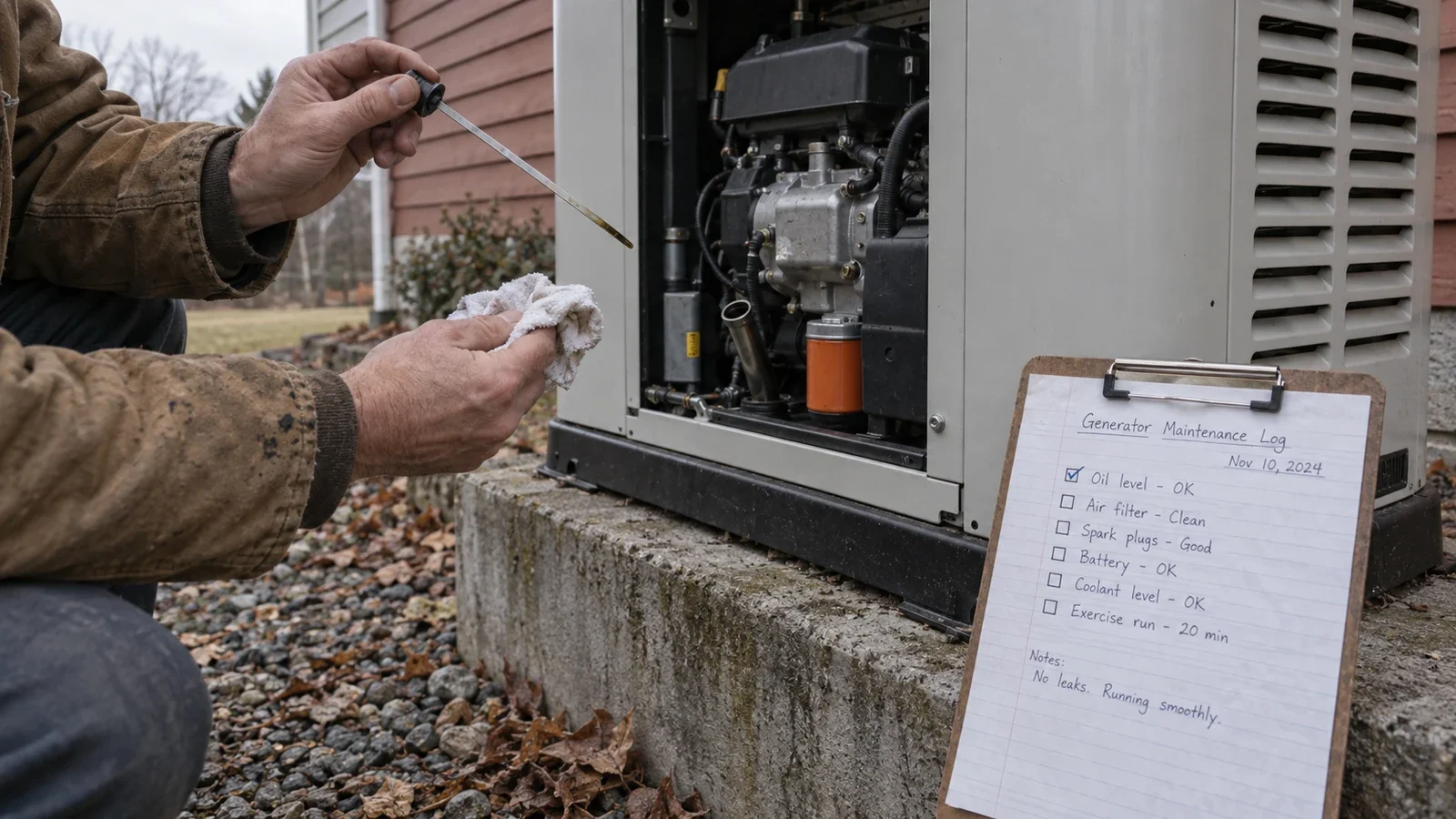
A whole-house standby generator is one of the few home systems that can sit idle for months and then be asked to run flawlessly during the exact week you need it most — which is why its maintenance schedule is built around both calendar time and actual run hours, not just "whenever it seems due."
The oil change schedule most manufacturers actually specify
The first oil and filter change happens early — commonly after the first 25 hours of run time — to clear out the fine metal particles normal in a new engine's break-in period. After that, a common pattern (Cummins is one example) is a second change at 100 hours, then every 200 hours after that. Generac and other standby-system manufacturers generally recommend a full professional inspection, including oil and filter service, every six to twelve months regardless of hours run, because oil absorbs moisture during long idle periods and degrades even when the engine barely runs.
| Interval | What to do |
|---|---|
| First 25 hours | First oil and filter change (break-in service). |
| Every 100–200 hours (varies by brand) | Subsequent oil and filter changes. |
| Every 6–12 months regardless of hours | Full professional inspection: oil, filter, battery check, load test. |
| Every 2–3 years | Battery replacement, even if it still starts the unit reliably. |
Why annual service matters even if the generator barely ran
It's tempting to skip a scheduled service on a generator that only ran its weekly self-test cycle and never carried a real load all year. That reasoning misses how oil actually degrades: it absorbs atmospheric moisture during long idle periods between run cycles, and that moisture breaks down the oil's protective properties over time independent of how many hours the engine actually turned over. A generator with low total hours can still have oil in worse condition than the hours alone would suggest.
The battery is the most common real-world failure point
Standby generators start with a conventional lead-acid battery, and that battery is doing double duty — sitting in a trickle-charge state for months at a time between starts, which is exactly the condition that shortens lead-acid battery life. Plan on replacing it every two to three years on a fixed schedule rather than waiting for a failed start to reveal the problem, since a dead starting battery means the whole system fails to do the one job it exists for, during an actual outage.
What a proper annual service actually includes
- Oil and filter change, plus a check of oil condition even between scheduled changes.
- Air filter and spark plug inspection or replacement on gas and propane units.
- Battery load test, terminal cleaning, and replacement on schedule rather than only on failure.
- Coolant level and condition check on liquid-cooled units.
- A real load-bank or transfer-switch test — confirming the unit actually picks up house load and transfers back cleanly, not just that the engine starts unloaded.
Running the weekly self-test doesn't replace the annual service
Most standby units run a short, automatic self-exercise cycle weekly, and it's a genuinely useful signal that the unit still starts. But a clean self-test only confirms the engine turns over and idles — it does not confirm oil condition, battery health under real load, or whether the transfer switch will pick up your actual house load during a real outage. Treat the weekly self-test and the annual professional service as two different, non-substitutable checks.
What a load bank test actually proves
A generator that starts and idles smoothly unloaded can still fail under real house load — a weak component, a marginal connection, or a transfer switch problem often only shows up once the unit is actually asked to carry your refrigerator, well pump, HVAC, and lighting simultaneously. A proper annual service includes either a real load-bank test or, at minimum, a supervised transfer-switch exercise that shifts your actual house load onto the generator briefly, rather than only confirming the engine runs with nothing connected to it.
Fuel matters as much as oil for propane and gas units
Stored fuel degrades. A propane tank feeding a standby unit should be checked for adequate level before storm season specifically, not just whenever it's convenient, since a generator with a dead battery and one with an empty or low propane tank fail for entirely different reasons that a single inspection point can miss if you're not checking both. For natural-gas-fed units, confirm the gas line and regulator haven't developed any signs of corrosion or damage since the last service, since these units are otherwise fuel-supply-independent of tank levels.
Is a generator maintenance contract with the installer worth it?
For most homeowners without the technical background to inspect an engine, a manufacturer-authorized service contract that bundles the annual inspection, oil changes, and battery checks into a scheduled visit removes the risk of the service being forgotten — which is the single most common reason standby generators fail when actually needed.
How long does a whole-house standby generator typically last?
With proper maintenance, air-cooled standby generators commonly last 10 to 20 years, though actual lifespan depends heavily on how often the unit runs under real load during frequent long outages versus mostly idling through its weekly automatic self-test cycle, and on whether oil, filter, and battery service were kept current the whole time.
Should I run my generator under load periodically, not just the self-test?
Yes, if your model's self-test only idles unloaded. Manually transferring some real house load to the generator for 20 to 30 minutes every few months (or during the annual service) helps reveal load-related problems before an actual outage does.
Carbon monoxide safety around the unit itself
Standby generators are installed outdoors specifically because they produce carbon monoxide, and manufacturers specify minimum clearances from windows, doors, and soffit vents for exactly this reason. As part of an annual check, confirm nothing has encroached on those clearances since installation — a deck addition, new landscaping, or stored items placed too close to the unit's exhaust side can quietly turn a code-compliant installation into a real hazard, independent of how well the engine itself has been maintained.
Keep the maintenance and load-test records in one place, ideally with the transfer switch's own documentation, since an insurance claim or a warranty dispute after a generator failure during an outage often turns on whether you can show a documented, regular service history rather than just an assertion that it was maintained. A folder with service dates, oil-change records, and battery-replacement dates costs nothing to keep and can matter significantly if a failure during a real outage ever becomes a dispute with a warranty provider or an insurer.
Ask your service technician to specifically note the transfer switch's condition at each annual visit, not just the generator engine itself — a transfer switch that fails to engage properly is functionally the same as a generator that never started, from the perspective of your house losing power during an outage.
Portable generators used as a backup instead of a permanently installed standby unit have their own separate maintenance pattern — fuel stabilizer for stored gasoline, more frequent oil changes relative to hours run, and no automatic transfer switch to test unless one was added separately. Don't apply the standby-unit schedule above directly to a portable generator; check that model's own manual, since duty cycle, run time between services, and battery requirements (if electric start) commonly differ from a permanently installed system.