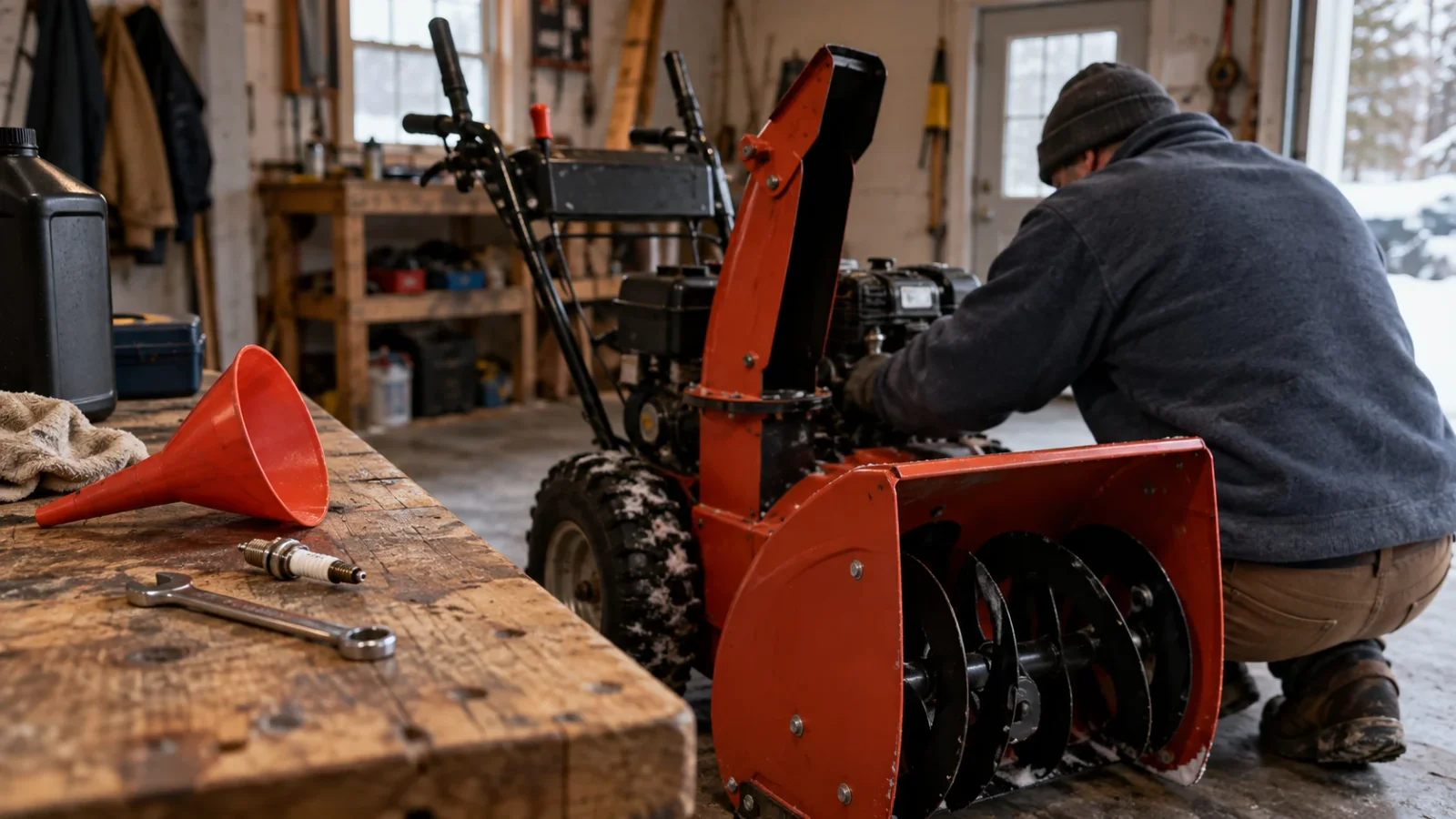
A pre-season service should end with an outdoor test while there is no storm pressure. That is when stale fuel, a weak plug, a worn belt or a damaged scraper is cheapest to discover.
Do the service before snow is in the forecast
| Cadence | Action | Planning logic |
|---|---|---|
| 4–6 weeks before typical first snow | Read the engine/machine manual and bring fuel strategy in line with it | Fuel guidance varies by engine and storage method. |
| Pre-season | Change or verify oil as specified; inspect for leaks | Cold starts punish neglected lubrication. |
| Pre-season | Inspect spark plug condition, belts, cables, shear pins, skid shoes, and scraper bar | Wear parts are easier to replace before a storm. |
| Pre-season | Check tires or track condition and inflation where applicable | Traction problems appear under load. |
| Pre-season | Start and run the machine outdoors; engage drive and auger briefly in a safe area | A machine that idles is not necessarily ready to move snow. |
| Storm kit | Store correct spare shear pins, fuel, basic tools, and manual access | Improvised bolts can damage the machine if used instead of shear pins. |
A driveway test is where hidden faults show up
- Stale fuel from last year is still in the system.
- Belts are cracked or glazed.
- Auger/drive will not engage cleanly.
- Fuel leaks or strong raw-fuel odor appear.
Never clear a chute or work around moving parts casually
Keep hands and feet away from auger/impeller, disable ignition before clearing or servicing as the manual requires, and use a dealer/technician for fuel leaks, internal drive faults, or repairs beyond your training.
If the machine is serviced and the remaining problem is a true no-start or performance fault, continue with a snowblower troubleshooting guide.
Store spares and record the fuel strategy you used
Move the service date earlier in high-elevation or early-snow areas. Coastal wet-snow regions place heavier load on belts and chute operation than dry powder climates.
A planned pre-season check avoids a first-storm failure and gives time to source model-specific wear parts. If the machine will not start or move snow correctly after the owner-manual service steps, use the manufacturer’s troubleshooting guide or a small-engine technician rather than repeatedly replacing parts without a diagnosis.
- Several weeks before snowRead the machine and engine manuals; identify fuel and service requirements.
- Pre-season serviceInspect wear parts and controls; address leaks or damaged parts.
- After serviceRun an outdoor test in a clear area and verify drive and auger operation.
- Before the stormStage model-specific spares and the manual where they are easy to find.
Finish the service with a no-pressure test run
Do the service several weeks before the first expected snow so there is time to obtain parts. Check engine oil, spark plug condition, fuel freshness, belts, scraper bar, skid shoes, controls, tires or tracks, and the manufacturer-specified shear protection against the equipment manual. Inspect for leaks, damaged guards, frayed cables, and hardware that has loosened during storage. The goal of this pass is to restore the machine to its documented service condition before weather urgency makes it tempting to skip a worn component.
Run the machine outdoors after service and let it reach normal operating condition. Test drive and auger engagement in a clear area without placing hands or feet near moving components. For a clogged chute, shut the machine down and use the clean-out tool and shutdown sequence specified by the manual—never reach into the chute or auger. Persistent surging, leakage, failed engagement, or abnormal vibration calls for troubleshooting before snowfall.
- Keep the exact oil, plug and shear-pin specifications with the machine record.
- Buy common wear parts before the first regional storm empties local stock.
- Test lights, electric start and battery systems if your model has them.
Stage model-specific spares where you can find them during a storm
Once the machine passes its fall service, build a small model-specific spares kit rather than a box of generic hardware. Keep the correct shear pins or approved fasteners, the oil specification, the spark-plug reference, and any tools the owner’s manual expects with the machine record. Note the fuel strategy and service date on the same record. This is logistics, not another tune-up: the purpose is to avoid discovering during a storm that the only bolt on hand is an unsafe substitute for a designed shear part.
A cold-start check can expose battery or starting weaknesses, but it is a separate observation from the warm driveway test. Keep it outdoors, use the maker’s cold-start procedure, and record what changed. If a fault appears only under load or in cold weather, give those conditions to the service technician; a repeatable symptom is more useful than another undirected tune-up.
Pre-season snowblower questions
How far ahead of the first snow should I run the snowblower?
Run it several weeks before your typical first accumulating snow, not the evening a storm is forecast. That gives you time to address stale fuel, battery, belt, cable or starting problems and to buy model-specific parts. In areas with highly variable first snow, use a local seasonal trigger such as the first sustained cold spell rather than a fixed date. Finish with an actual test run so the checklist verifies operation, not just appearance.
Which wear parts are worth checking before the machine is actually needed?
Check the wear items that can stop snow removal quickly: belts, scraper bar, skid shoes, shear pins or bolts specified for the machine, auger and drive controls, tires or tracks, and the starting system. Service oil, spark plug and fuel according to the engine manual. Keep correct spare shear pins available; substituting ordinary hardware can defeat the protection the manufacturer designed into the auger system.
What should I do if the snowblower fails its pre-season test run?
Do not wait for the first storm. Recheck the fuel and starting steps from the manual, confirm controls are in the correct positions and inspect obvious connections or wear. If it still will not start, drives poorly or the auger system does not work after routine service, switch to model-specific troubleshooting instead of adding more maintenance steps. A serviced machine that still has a real operating fault needs diagnosis, not another generic tune-up.