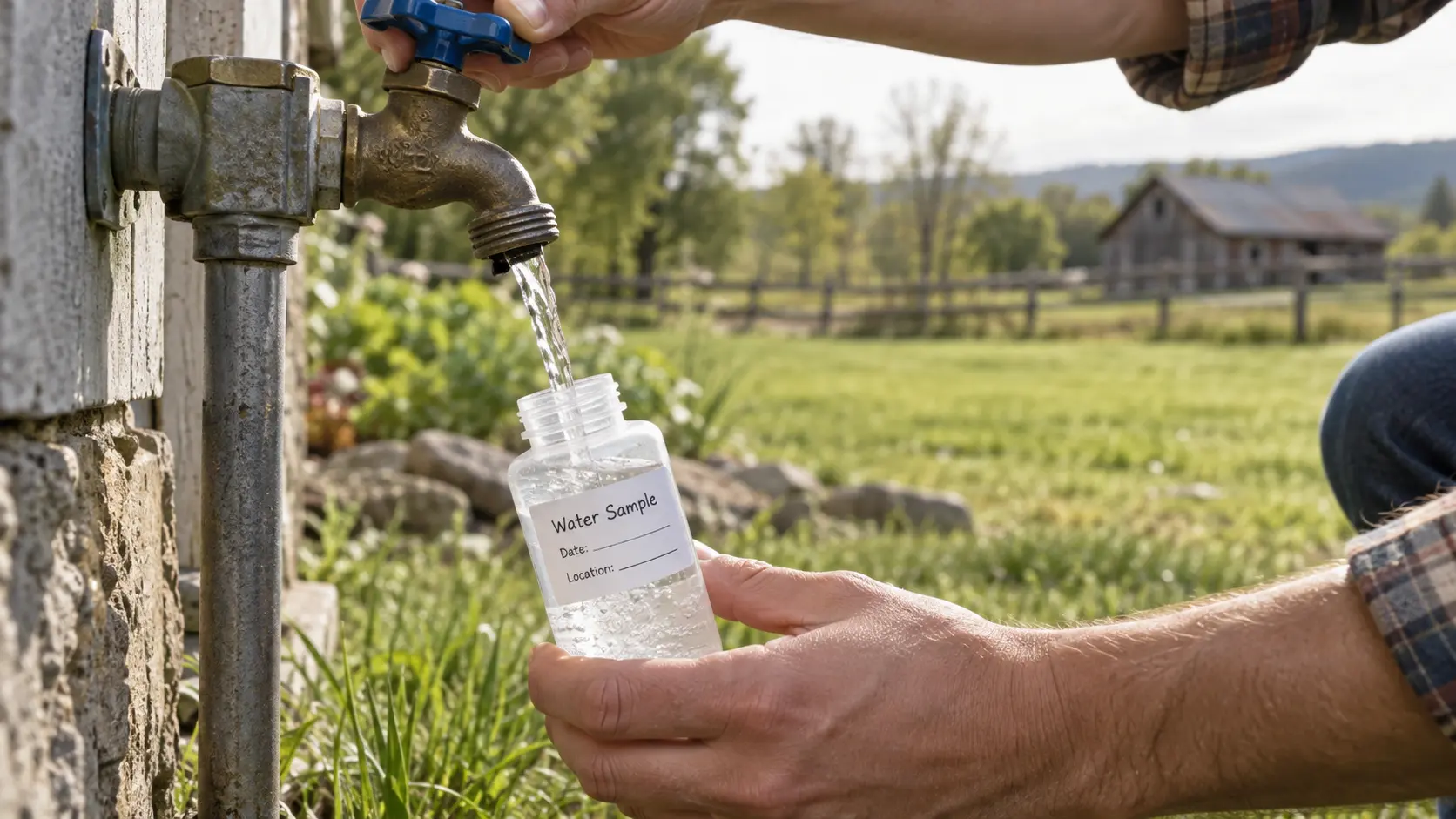
Private wells are not regulated, treated or monitored by government officials in the same way as public water systems, so the owner needs a recurring test and service record. CDC recommends annual testing for total coliform bacteria, nitrates, total dissolved solids and pH, using a state-certified laboratory. Contact the local health department for contaminants relevant to nearby land use and geology; appearance and taste cannot establish that water is safe.
CDC's recommended testing interval
CDC guidance recommends testing private well water at least once a year for total coliform bacteria, nitrates, total dissolved solids, and pH. Beyond this baseline, CDC recommends contacting your local health department to find out whether additional contaminant testing makes sense for your specific area — things like volatile organic compounds, lead, arsenic, mercury, radium, or agricultural pesticides and herbicides, depending on regional geology and land use nearby.
Add targeted tests after well repairs or damage, flooding, a change in water taste or appearance, or a nearby contamination event. Test nitrate before an infant uses well water and ask the health department or clinician how to interpret the result. Infants are especially vulnerable to nitrate; do not prepare infant formula with water above the applicable nitrate limit. A routine panel does not screen for every possible contaminant, so build the test list from local conditions and the well’s history.
What each baseline test actually tells you
| Test | What it indicates |
|---|---|
| Total coliform bacteria | Presence suggests possible contamination pathway into the well, even if the specific bacteria found isn't itself harmful |
| Nitrates | Elevated levels can indicate agricultural runoff or septic system influence nearby, and pose specific risk to infants |
| Total dissolved solids | General indicator of overall water mineral content, affecting taste and potentially indicating other issues |
| pH | Affects both water taste and how corrosive the water may be to plumbing over time |
Beyond water quality: the physical well and pump system
Along with lab testing, inspect the well cap and casing from the surface for damage, keep the area around the wellhead clear of stored chemicals and animal waste, and make sure surface water drains away. Keep a sketch or location record for the well, septic system and nearby fuel or chemical storage so a professional can assess potential pathways. Pump cycling, pressure changes, air sputtering, sediment or sudden discoloration deserve investigation; do not open electrical controls or enter a well pit.
Practical steps for well owners
- Test annually at minimum for the CDC baseline panel (coliform bacteria, nitrates, total dissolved solids, pH), using a certified laboratory rather than an at-home kit alone for anything beyond a quick screening check.
- Contact your local health department to ask what additional contaminants are worth testing for given your specific region's geology and land use.
- Test after any noticeable change in water taste, color, odor, or pressure, rather than waiting for your next scheduled annual test.
- Keep the wellhead area clear of standing water, chemical storage, and other contamination risks.
- Keep records of your test results over time so you can spot a gradual trend, not just a single reading.
Why this genuinely matters more than it might seem
Because there's no automatic oversight the way there is with a municipal water supply, a private well can develop a contamination problem that persists undetected for a long time if testing lapses. Treating annual testing as a fixed calendar item — the same way you'd treat an HVAC filter change or a smoke alarm battery — is the most reliable way to catch a developing problem early rather than after it's affected your household's health.
If you're buying a home with an existing private well, don't rely solely on the seller's disclosure of past test results — request the actual lab reports if available, and strongly consider ordering your own independent test as part of your purchase process regardless of what you're told about the well's history. A well that tested clean five years ago tells you very little about its current condition, and a pre-purchase test is one of the few chances you'll have to establish your own accurate baseline before you're responsible for the system.
If your test results ever come back with an elevated reading, don't rely on taste, smell, or appearance to judge whether the problem is resolved after treatment — many common well water contaminants, including nitrates and several bacteria, produce no noticeable change in how the water looks, tastes, or smells even at levels that matter for health. A confirming retest after any treatment or repair is the only reliable way to know the issue actually improved.
How often should I test my private well water?
CDC guidance recommends testing at least once a year for total coliform bacteria, nitrates, total dissolved solids, and pH, with your local health department able to advise on additional contaminants worth testing based on your specific region's geology and land use nearby.
Do EPA drinking water regulations apply to my private well?
No. EPA's public drinking water regulations apply to municipal water systems, not private wells, which means there's no automatic regulatory testing on your behalf — responsibility for testing and maintaining water quality falls entirely on the well owner.
Who should test their well water more often than annually?
Test after well damage or repair, flooding, a sudden water-quality change or a local contamination event. Ask the health department about targeted testing before an infant uses the water and about any local contaminants or schedules. The annual CDC panel remains a useful baseline, but it does not test for every possible contaminant.
Should I test well water before buying a home?
Yes. Request the existing lab reports and well records, then arrange a current test through a state-certified laboratory before relying on the water. Ask the local health department which contaminants to include based on location and known land use; test results from several years ago cannot establish current water quality.
| Bacterial result | Chemical result | |
|---|---|---|
| Possible next step | Use the specified shock-chlorination protocol, then retest. | Ask the health department or water-treatment professional about the substance and level. |
| Confirm resolution | Retest before resuming normal use. | Test to confirm the chosen treatment addressed the result. |
| Avoid | Do not assume treatment worked without a retest. | Do not assume boiling removes nitrates or heavy metals. |
What to do if your test results come back positive for a contaminant
A result above a health-based value needs a contaminant-specific response from the health department, laboratory or qualified water professional. For bacterial contamination, follow local disinfection instructions and submit a confirmation sample before assuming the problem is resolved. For nitrate and many chemical contaminants, boiling is not a remedy and can concentrate the contaminant as water evaporates; use an alternate safe source for drinking and infant formula while obtaining guidance. Treat only with a system certified for the contaminant and retest after installation.
Avoid assuming that boiling water addresses every possible contamination issue — boiling is effective against many biological contaminants but does nothing for chemical contaminants like nitrates or heavy metals, and can actually concentrate some chemical contaminants as water evaporates. Match your response to the specific contaminant identified in your test results rather than applying a single general precaution to every possible result.