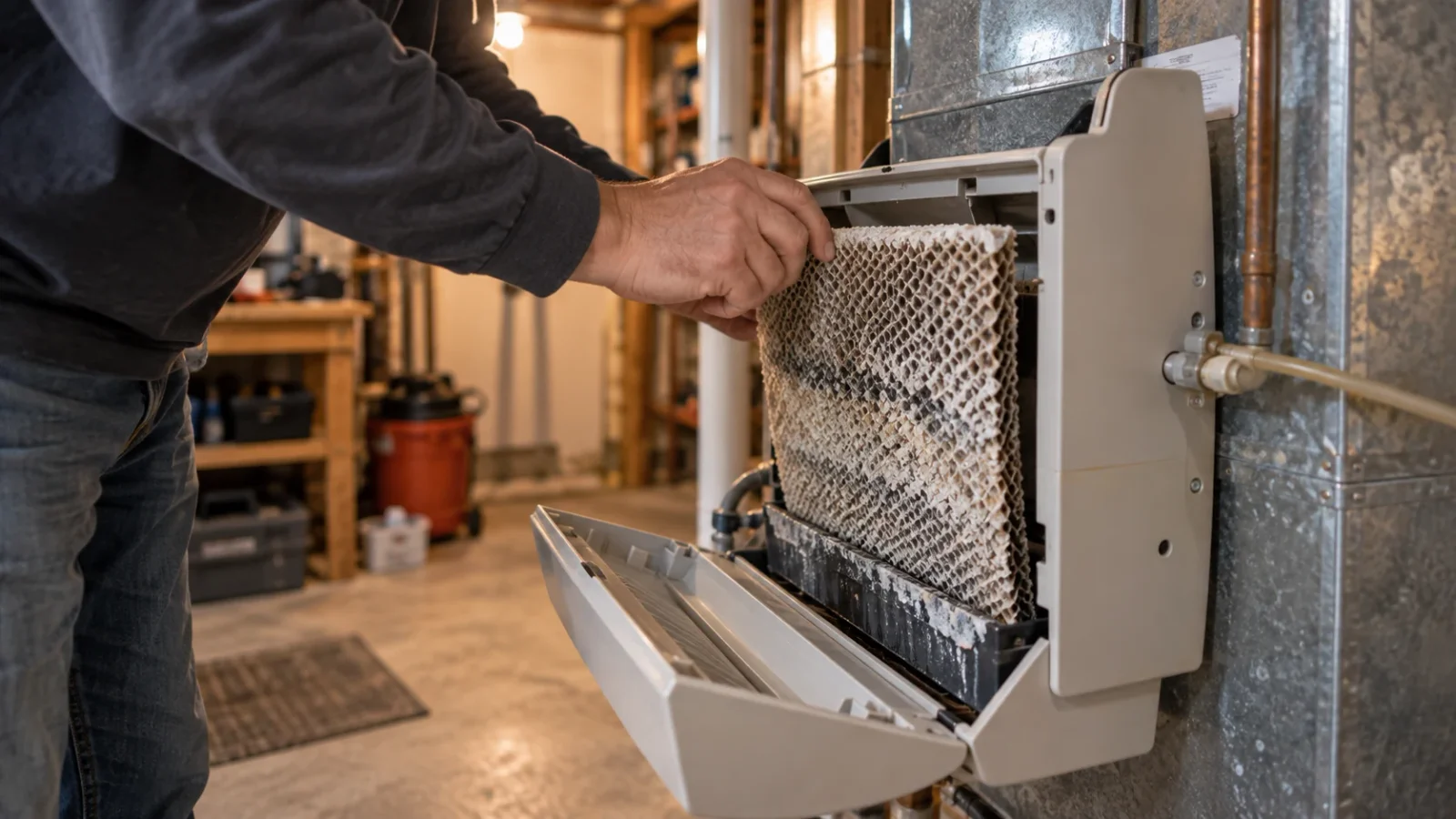
Whole-house units vary enough that the furnace-mounted humidifier manual is the primary source for pad or panel replacement. The annual pre-season visit is still a useful moment to inspect the water path, drain and seasonal damper before the system runs continuously.
Service the unit before sustained heating demand
| Window | Maintenance checkpoint | What changes the date |
|---|---|---|
| Before heating season | Replace/clean the evaporative panel or service element per manufacturer instructions | Mineral loading can reduce water distribution and airflow. |
| At service | Clean accessible scale from housing and distribution tray without damaging coatings | Scale patterns can also reveal uneven water flow. |
| At service | Inspect drain tubing and nearby floor for leaks or blockage | A small humidifier leak can become hidden furnace-room damage. |
| First cold weeks | Set humidistat conservatively and lower it if windows condense | Outdoor temperature and window performance affect safe indoor humidity. |
| Spring shutdown | Close bypass damper or water supply if the manual calls for it | Leaving a bypass open can affect cooling-season airflow. |
| Any time output disappears | Check the simple maintenance items before assuming a control failure | A clogged pad or closed damper can mimic a fault. |
No output after service is a fault, not a reason to over-humidify
- Water runs continuously when it should not.
- Drain backs up.
- No water reaches pad despite correct seasonal setup.
- Condensation forms broadly through the house.
Water-solenoid and furnace-control work may require a technician
Solenoid replacement, line-voltage wiring, furnace interlocks, internal HVAC controls, and plumbing changes belong to qualified service if you are not trained for them.
If annual service is complete but the system still will not add moisture, continue with a focused humidifier fault guide.
Outdoor temperature and window condensation should influence the setting
In very cold weather, indoor RH may need to be lower than your normal winter target to avoid window and wall condensation. EPA’s 30–50% range is a general indoor target, not a command to maintain 50% during a deep freeze.
After a new panel or cleaning, observe a full heating call and verify the control responds, the feed stops when humidification stops, and the drain carries water without leaking. A clean-looking component alone does not establish operation. During very cold weather, reduce the set point if windows or walls collect moisture.
After annual service, confirm the system actually responds. A new water panel or cleaned service element does not prove the feed valve, drain, humidistat or bypass damper is working correctly. Watch for water that runs continuously, a drain that backs up, or indoor humidity that does not respond to settings. In very cold weather, lower humidity may be necessary to prevent window or wall condensation even when the humidifier itself is operating normally.
Use the furnace-mounted unit’s manual as the final authority
Identify the model and review its instructions before opening the cabinet. Water panels, feed tubes, drains, and seasonal bypass dampers vary by design; clean or replace only the listed service parts and interval. If the equipment is connected to a furnace interlock, do not bypass that control to force operation.
If the unit produces no humidity after routine panel, drain, and damper care, do not compensate by turning the humidistat much higher. A failed solenoid, control signal, water supply, or furnace interlock may require qualified service. Stop and diagnose standing water or a leak near the furnace.
- Record the water-panel or pad part number so replacement is easy next season.
- Check the drain during operation; a clean-looking pad does not prove the drain is open.
- Close or reposition the seasonal damper in summer only as the equipment instructions specify.
- Heating startupCheck the panel, water path, drain, control response, and seasonal damper per the manual.
- During operationWatch for continuous flow, backed-up drainage, or persistent condensation.
- Spring shutdownFollow the model’s steps for water supply, cleaning, drying, and damper position.
- Next seasonKeep the service date and part number with the furnace record.
Treat startup and shutdown as two different maintenance events
At shutdown, follow the model’s off-season steps for the water supply, scale, cabinet, and damper position. Leave the unit dry if instructed and note any part needed for next season. A seasonal shutdown record prevents stagnant water or an unnoticed open feed from remaining until the next heating call.
At shutdown, do not simply turn the humidistat down and walk away. Follow the manufacturer’s off-season procedure for closing water supply where applicable, cleaning mineral deposits, leaving the cabinet dry, and setting any seasonal damper. Record the service date beside the furnace record so the humidifier does not become an invisible accessory that receives attention only after it leaks or stops producing moisture.
Whole-house humidifier questions
When should a whole-house humidifier be serviced for heating season?
Schedule service before or at the start of heating season, when the humidifier is about to return to regular use. Follow the manufacturer for water-panel or pad replacement, cleaning, damper position and humidistat setup; some homes with hard water need attention more often. Starting early gives you time to correct a clogged drain, failed water feed or control problem before dry winter weather makes the lack of output noticeable.
Why should the drain and water panel be checked together?
The water panel or evaporative pad can only do its job if water reaches it and then drains correctly. Scale or blockage on the pad can reduce evaporation, while a clogged drain can create leakage or standing water. Inspect the feed, distribution tray, panel and drain as one water path rather than replacing a pad and assuming the system is serviced. Follow the specific unit manual because designs differ substantially.
What does it mean if the humidifier still produces little moisture after service?
First confirm the obvious service items: water supply is open, the panel is correctly installed, the drain is clear, the damper is in the heating-season position if the design uses one, and the humidistat is calling appropriately. If output remains poor, the fault may involve a solenoid, sensor, control, airflow or other component. That is the point to move from routine maintenance into model-specific troubleshooting or professional service.