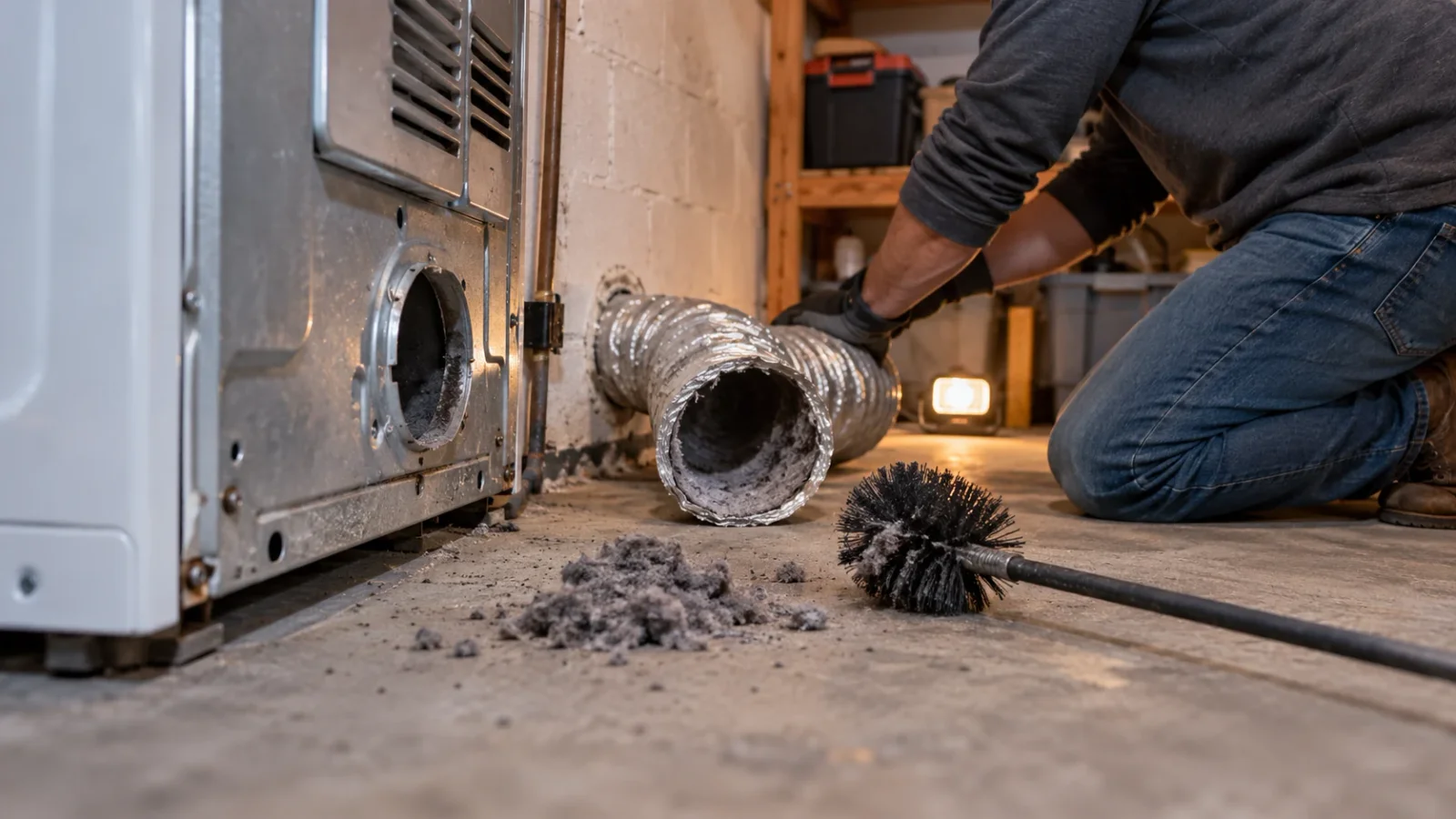
CPSC warns that lint buildup in the dryer or exhaust duct can restrict airflow and contribute to fire. Longer-than-normal drying time, excess heat and weak exterior exhaust are practical triggers to inspect the path before the calendar says it is due.
Start with airflow, not an arbitrary anniversary
| When / trigger | What to do | Why it sits here |
|---|---|---|
| Every load | Clean the lint filter | This is the first barrier against lint moving into the exhaust path. |
| Monthly glance | Confirm the exterior flap opens strongly while the dryer runs | Weak airflow can signal restriction. |
| At least yearly | Clean the full exhaust path, including accessible duct and exterior termination | CPSC recommends periodic vent and exhaust-duct cleaning; GE Appliances recommends inspecting and cleaning dryer exhaust ducting at least yearly. |
| After moving dryer | Check that the duct is not crushed, disconnected, or sharply kinked | A pushed-back dryer can create a restriction. |
| Any time drying slows | Stop treating long cycles as normal and inspect airflow | Long dry times are a practical warning sign. |
| During replacement | Use code- and manufacturer-appropriate rigid/semi-rigid metal ducting rather than improvised plastic/vinyl | Material and route affect heat, lint accumulation, and airflow. |
Lint, heat and long dry times are early warnings
- Clothes take longer than normal to dry.
- Dryer or laundry room becomes unusually hot or humid.
- Burning/lint odor appears.
- Exterior airflow is weak despite a clean lint screen.
When the duct route needs a technician, not a brush kit
If the exhaust route is long, concealed, roof-terminated, inaccessible, damaged, or near electrical/gas components you are not qualified to service, use a professional dryer-vent service or appliance technician.
Choose the service scope from the duct route
Long runs, several elbows, concealed sections, roof terminations, pet hair, and frequent laundry can make the full route harder to inspect and may justify earlier service. Record where the duct travels and where it exits so a technician can clean and check the entire path. Model-specific instructions control the interval; recurring lint or weak airflow is a reason to investigate sooner.
Before service, note whether the dryer vents through an exterior wall or roof and whether the transition duct is visible behind the appliance. A short, accessible route may allow a homeowner to inspect the outlet from a safe position, but the dryer should be disconnected only when the owner can do so safely and according to the manual. Never use a leaf blower or force a brush into a concealed duct; either can push lint deeper or damage a joint.
If the dryer is gas-fired, close the shutoff and reconnect gas only as the manufacturer specifies; stop and call a qualified technician if a fitting moves or you smell gas. For electric models, do not open energized panels. A fire-prevention task should not introduce a gas leak, electrical shock, or a disconnected exhaust joint.
If airflow remains poor after the accessible path is clean, ask whether the route itself is crushed, excessively long, or difficult to service instead of buying repeated brushes or vent gadgets.
Build a normal-drying baseline and close the vent safely
After confirming the vent is clear, use one ordinary load as a household reference: note whether drying time seems normal, the room stays reasonably comfortable, and the outside flap opens while the dryer runs. This is a comparison point, not a precise test. A later change can trigger an earlier inspection; also consider load size, fabric, cycle choice, and appliance condition before concluding the duct is blocked.
Clean the lint screen every load and keep lint and stored items away from the dryer. After vent service, reconnect the duct securely and verify the outside termination is open. CPSC advises against plastic or foil accordion-style ducts; use a listed metal transition duct that follows the appliance and local code instructions. If the connection is crushed, inaccessible, roof-terminated, or near gas or electrical components, leave correction to qualified service.
- Do not treat a hotter dryer or longer cycle as normal aging; airflow should be checked.
- Avoid pushing the dryer back hard enough to crush or kink the transition duct.
- After cleaning, verify airflow at the exterior termination before calling the job complete.
Dryer-vent questions
Is once-a-year dryer vent cleaning enough for every house?
Not necessarily. CPSC advises periodic cleaning of the dryer vent and exhaust duct, while manufacturer schedules vary; GE Appliances recommends at least yearly inspection and cleaning, and other manufacturers may specify a different interval. Heavy use, a long or complex duct, pets and recurring lint accumulation justify checking sooner. Clean the lint screen every load and treat longer drying time, weak exhaust flow or unusual heat as reasons to inspect the exhaust path before the calendar reminder.
What does longer drying time say about the exhaust path?
Longer drying can mean moist air is not leaving the machine efficiently. A clogged lint screen, crushed transition duct, blocked exterior hood or lint buildup in a long vent can restrict airflow; appliance faults can cause similar symptoms. Check the accessible exhaust path and exterior airflow, then stop using the dryer and seek service if heat, burning odor or performance remains abnormal rather than compensating with longer cycles.
Which dryer-duct layouts are poor candidates for a DIY brush kit?
Routes that run several stories, disappear through finished ceilings, have many bends, terminate on a roof, or cannot be reached from both ends are poor DIY candidates. The same is true when the duct is damaged or made from an unsuitable material that needs replacement. Professional cleaning can verify the full route and airflow without disconnecting hidden sections or working from a hazardous roof or ladder position.
Reconnect the duct securely and confirm the exterior outlet is unobstructed with a strong exhaust stream. Do not push the dryer back hard enough to crush or kink the transition duct.