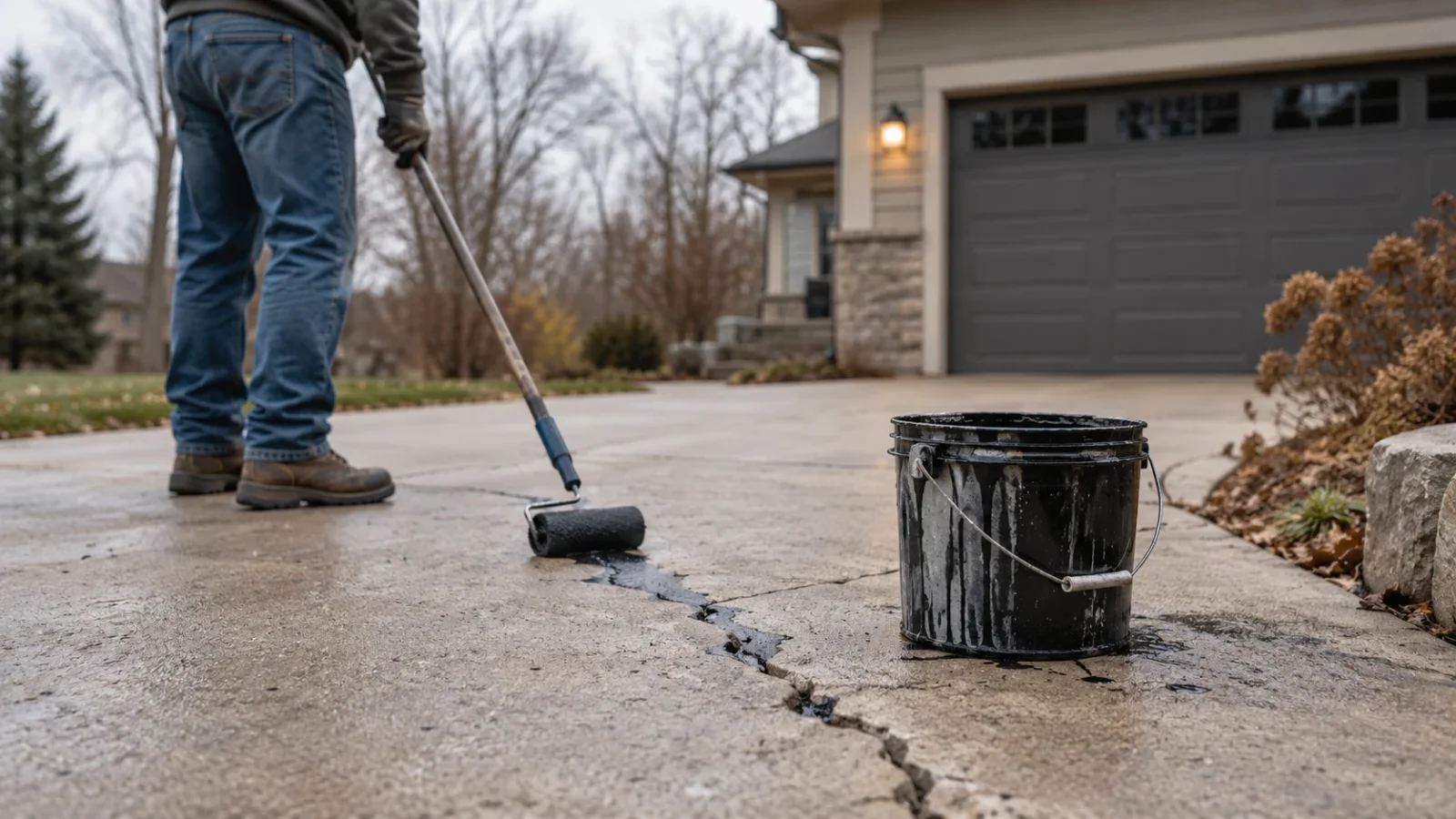
Sealer is not a cure for movement. First identify asphalt, concrete or pavers, then repair cracks and drainage problems before deciding whether the surface actually needs another protective treatment.
- Crack has vertical displacement.
- Settlement directs water toward foundation.
- Repeated heaving returns after repair.
- Large area breaks under vehicle load.
Start by identifying the paving material
| Cadence | Action | Planning logic |
|---|---|---|
| Every spring | Map new cracks, settlement, trip edges, drainage paths, and vegetation intrusion | Freeze-thaw and plowing often reveal winter damage. |
| Asphalt yearly | Fill appropriate cracks before water widens them; inspect previous sealcoat condition | Small cracks are easier to manage early. |
| When wear or product guidance suggests | Decide whether sealcoating is actually needed based on wear and product guidance | Use condition and product guidance; avoid treating a date as a requirement. |
| Concrete | Inspect control joints and cracks; use compatible repair/seal products | Do not treat every crack as structural failure. |
| Pavers | Top up joint material and correct localized settlement before edges unravel | Loss of restraint can spread. |
| Before winter | Fix trip hazards and drainage that will become ice hazards | Water location matters as much as surface color. |
Measure movement before deciding the problem is a sealing job
Take a photo of recurring cracks from the same angle with a ruler or other scale and note whether the two sides remain level. A narrow surface crack that is stable behaves differently from a joint that widens every winter, a slab that heaves, or a walkway edge that creates a trip hazard. Also watch the area during rain or snowmelt. Water that repeatedly ponds or runs beneath an edge can be more important than the visible crack itself.
Choose repair and coating products only after confirming the paving material. Asphalt, poured concrete, and pavers use different crack treatments, joints, sealers, and preparation. In freeze-thaw climates, deicers and trapped water can accelerate deterioration; in hot climates, surface aging and movement follow a different pattern. Significant settlement, drainage failure, or displaced slabs call for a paving or concrete professional rather than another cosmetic sealing cycle.
For asphalt, track cracks, raveling and low spots that hold water. For concrete, look at control joints, surface scaling, spalling and movement between slabs. For pavers, watch joint-sand loss, weeds, settlement and edge restraint. These failure modes need different maintenance; a universal “seal every two years” reminder can waste money or hide the real problem.
Repair drainage and active cracks before applying another coating. Freeze-thaw climates deserve earlier attention to water entering cracks because repeated freezing can increase damage. Deicer chemistry can also affect concrete, so follow material and product guidance. If slabs are heaving, a driveway is sinking toward a structure, or settlement creates a significant trip hazard, the job has moved beyond a cosmetic sealing cycle and may need a paving, concrete or drainage professional.
- Keep a photo of the same representative crack so you can see whether it is stable.
- Do not seal over dirt, moisture or failed old coating that the new product cannot bond to.
- Choose application weather from the actual sealer label, not from the calendar month alone.
Freeze-thaw and deicer exposure change the cycle
Freeze-thaw and road-salt regions age paving differently from hot dry climates. Tree roots, clay soils, and heavy vehicles can dominate the schedule.
Sealant is not a substitute for base repair. Spend on drainage, crack control, and trip-hazard correction before cosmetic blackening or surface appearance.
Do not coat over active movement, drainage failure, or a trip hazard. Sealer is a surface treatment, not structural repair.
Large structural movement may need a paving or concrete contractor
Major settlement, drainage redesign, structural slab movement, or work near buried utilities may require a paving contractor, concrete specialist, engineer, or utility locating service.
For repairs, match the product to the crack width, surface and expected movement, and read the temperature and cure limits before scheduling work. A filler that is too rigid for a moving joint can reopen; a coating applied over damp or dirty pavement may not bond. Keep photographs and mark the ends of a crack so the next inspection can show whether it has lengthened. On a sloped driveway, check that water flows to a safe outlet rather than toward a garage, foundation or neighboring property. Avoid patching over drainage inlets or covering control joints with a product that prevents their intended movement. For any repair beside buried utilities, arrange utility locating before digging or cutting.
Driveway and walkway questions
Does asphalt, concrete, and paver maintenance follow the same schedule?
No. Asphalt, concrete and pavers fail in different ways and use different maintenance products. Asphalt commonly needs crack control and periodic sealcoat decisions; concrete needs attention to cracks, joints and compatible sealers; pavers may need joint-sand and edge maintenance. Follow the material and product guidance rather than putting every surface on the same two-year cycle. The shared goal is to control water, movement and trip hazards before surface cosmetics.
Which cracks should be repaired before any sealer is applied?
Repair cracks that admit water, are widening, show edge breakdown or are associated with movement before covering the surface with sealer. Also correct drainage or base problems when cracks keep returning. Vertical displacement that creates a trip hazard is more important than hairline appearance and may need leveling or reconstruction rather than filler. Sealer is a protective finish; it is not a structural repair for a moving slab or failing base.
How does freeze-thaw weather change walkway maintenance priorities?
Freeze-thaw climates make water entry and drainage more urgent because trapped water expands as it freezes. Keep joints and cracks from collecting water, repair spalling early, and avoid products or deicers that are inappropriate for the surface. Snowplow edges can also damage raised sections. Schedule repairs during suitable curing temperatures before winter rather than discovering in spring that a small water path has become a larger broken edge.