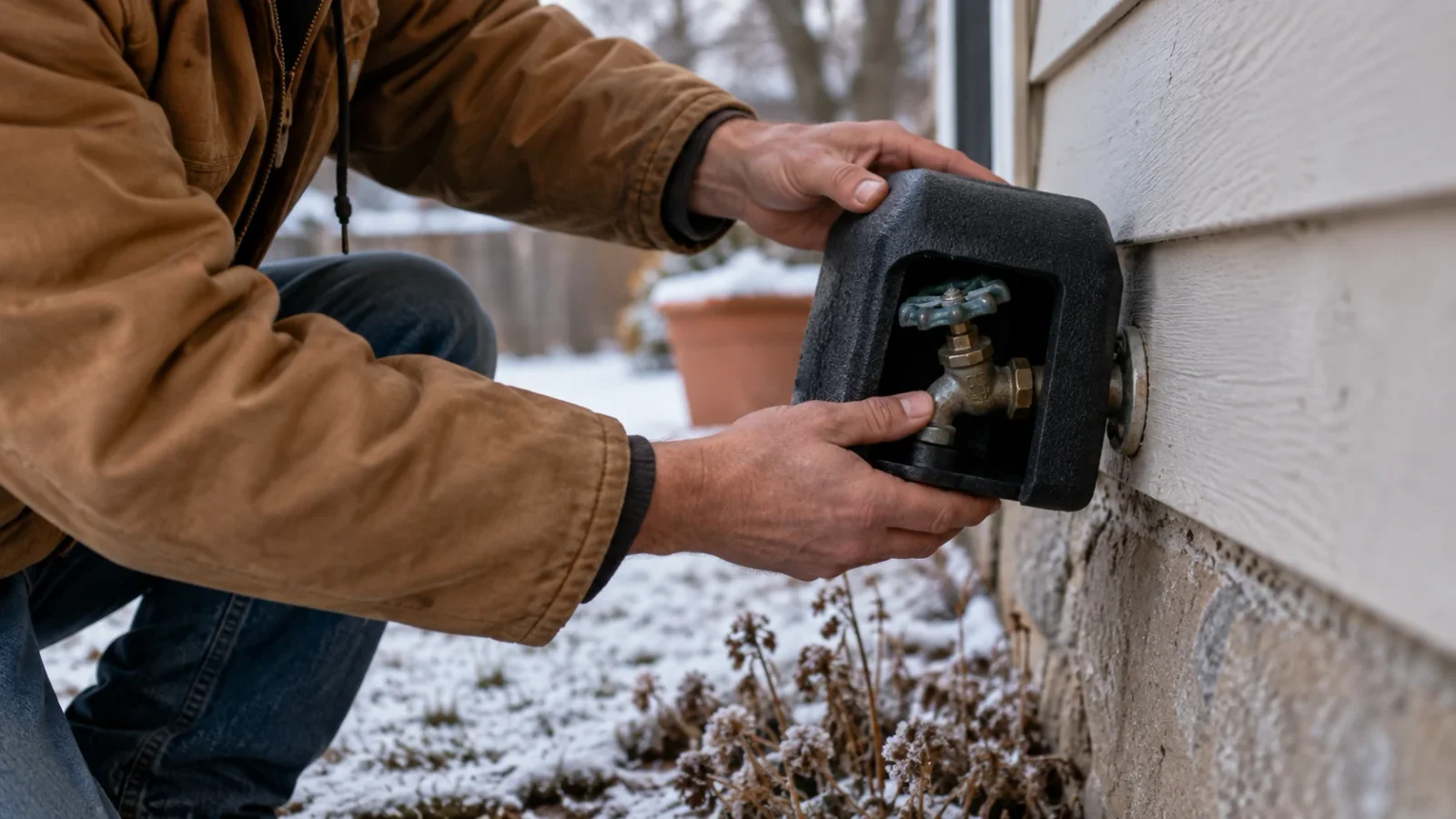
Do this before the local first-freeze window, not on a fixed national date. Frost-free faucets, interior shutoff valves, backflow devices and irrigation zones can require different steps even on the same property.
Work backward from your local freeze risk
| When / trigger | What to do | Why it sits here |
|---|---|---|
| Before first freeze | Disconnect every hose, splitter, timer, and spray nozzle | Attachments can trap water even on a frost-free faucet. |
| If an interior shutoff exists | Close it, then open the exterior faucet to drain as designed | The goal is to empty the vulnerable section. |
| Frost-free faucet | Confirm it slopes/drains and does not have a hose attached | A frost-free design can still freeze if water cannot drain. |
| Irrigation shutdown | Follow controller, valve, backflow, and blowout instructions for the system | Compressed-air blowout has pressure hazards and equipment-specific limits. |
| After shutdown | Label which valves are closed and photograph controller settings | Spring startup becomes easier and safer. |
| First thaw | Inspect exterior wall and basement/crawlspace near faucets for leakage | Freeze damage may appear only after thaw and repressurization. |
Different outdoor water systems need different shutdowns
A hose bib with an interior shutoff can usually be isolated and drained differently from a frost-free sillcock, and both are different from a multi-zone irrigation system with backflow prevention. Identify what you have before turning valves. Disconnect hoses and attachments so water cannot stay trapped at the outlet. If an interior isolation valve exists, close it as intended and open the exterior fixture to drain only when that matches the installation design.
Irrigation blowout can damage piping, valves or components when pressure and procedure are wrong, so follow the controller and irrigation manufacturer instructions and use a qualified service provider when compressed-air winterization is required. The timing should track your local first-freeze risk. In spring, repressurize slowly and inspect indoor and outdoor areas near freeze-prone piping for delayed leakage; some freeze damage is not obvious until water pressure returns.
- Remove quick-connects, splitters and timers that can trap water at a faucet.
- Protect exposed backflow components only in ways allowed by local requirements and the device maker.
- Do not assume a frost-free faucet is protected if a hose was left attached and holding water.
A slow drain or hidden valve can defeat winterization
- Exterior faucet drips after shutoff.
- Interior valve will not close.
- Backflow preventer is cracked.
- Water appears inside after spring startup.
Do not assume a frost-free faucet makes a connected hose harmless
A frost-free sillcock relies on water draining from the vulnerable exterior portion after it is shut. A hose, splitter, timer, or closed attachment can trap water where the fixture was designed to empty. Remove attachments before freezing weather and follow the fixture maker’s instructions. Conventional exterior faucets may also have an interior shutoff and drain arrangement; identify the actual plumbing before copying a neighbor’s winterization routine.
Irrigation systems are a separate decision. Backflow devices, valves, low spots, and long buried zones can retain water even when the controller is off. Compressed-air blowout uses stored energy and can damage components when pressure or procedure is wrong, so follow the irrigation manufacturer’s limits or hire a qualified irrigation professional. In spring, reopen water slowly and inspect exposed joints and valve boxes for leaks that only become visible after pressure returns.
- Before local freeze riskRemove hoses and attachments; isolate and drain only as the installation allows.
- Fall shutdownLabel closed valves and save controller settings.
- Spring startupRestore pressure slowly and test each exposed area for leaks.
- After thawCheck inside walls and near faucets for delayed leakage.
Reopen slowly in spring and watch for delayed leak evidence
When freezing risk has passed, restore outdoor water in stages. Reopen an interior isolation valve slowly, close the faucet drain as designed, and inspect the exposed pipe and indoor wall penetration before leaving the system pressurized. For irrigation, open the supply gradually and walk each zone while it runs so split fittings or cracked backflow parts are found before normal scheduling resumes.
Winterization is a small planned task compared with repairing a split pipe inside a wall. If a valve is seized, the plumbing layout is unknown, or professional irrigation blowout is required, arrange the service before the first local freeze window rather than improvising under time pressure.
Compressed-air blowout deserves professional judgment
Compressed-air irrigation blowout can injure people or damage components; hire an irrigation professional if you do not have the correct equipment, pressure limits, and procedure. Plumbing repairs inside walls also warrant a plumber.
At spring startup, note which valves were reopened and check the backflow assembly, accessible pipe joints, and each irrigation zone for seepage. Keep the winterization record with the system map so the next shutdown does not depend on remembering which valve or drain was used.
Winterization questions
When should outdoor faucets be winterized relative to the first freeze?
Finish the work before the first hard freeze, allowing extra time if a contractor handles irrigation. Disconnect hoses early because trapped water can defeat the protection of some sillcocks. For a conventional faucet with an interior shutoff, follow the plumbing arrangement for closing and draining it. Local freeze depth and system design matter more than a national calendar date, so use your area's first-freeze history and forecast as the trigger. Add a reminder a week ahead so contractor availability is not the bottleneck.
Is a frost-free sillcock maintenance-free?
No. Frost-free designs reduce freeze risk by placing the shutoff deeper inside the conditioned wall, but they still depend on correct installation, drainage and a hose-free outlet. A connected hose or accessory can trap water in the barrel. Inspect for leakage, make sure the faucet can drain as intended and follow the manufacturer's winter instructions. A frost-free label is protection by design, not permission to ignore the fixture.
When is sprinkler blow-out work better left to an irrigation professional?
Leave blow-out work to an irrigation professional when you do not know the system's pressure limits, lack the correct regulated air supply, have complex backflow equipment, or cannot isolate zones safely. Compressed air can damage components and can create injury hazards when used incorrectly. Many systems also have local backflow requirements. Draining accessible hose bibs is one thing; pressurizing an underground irrigation network is a different risk class.