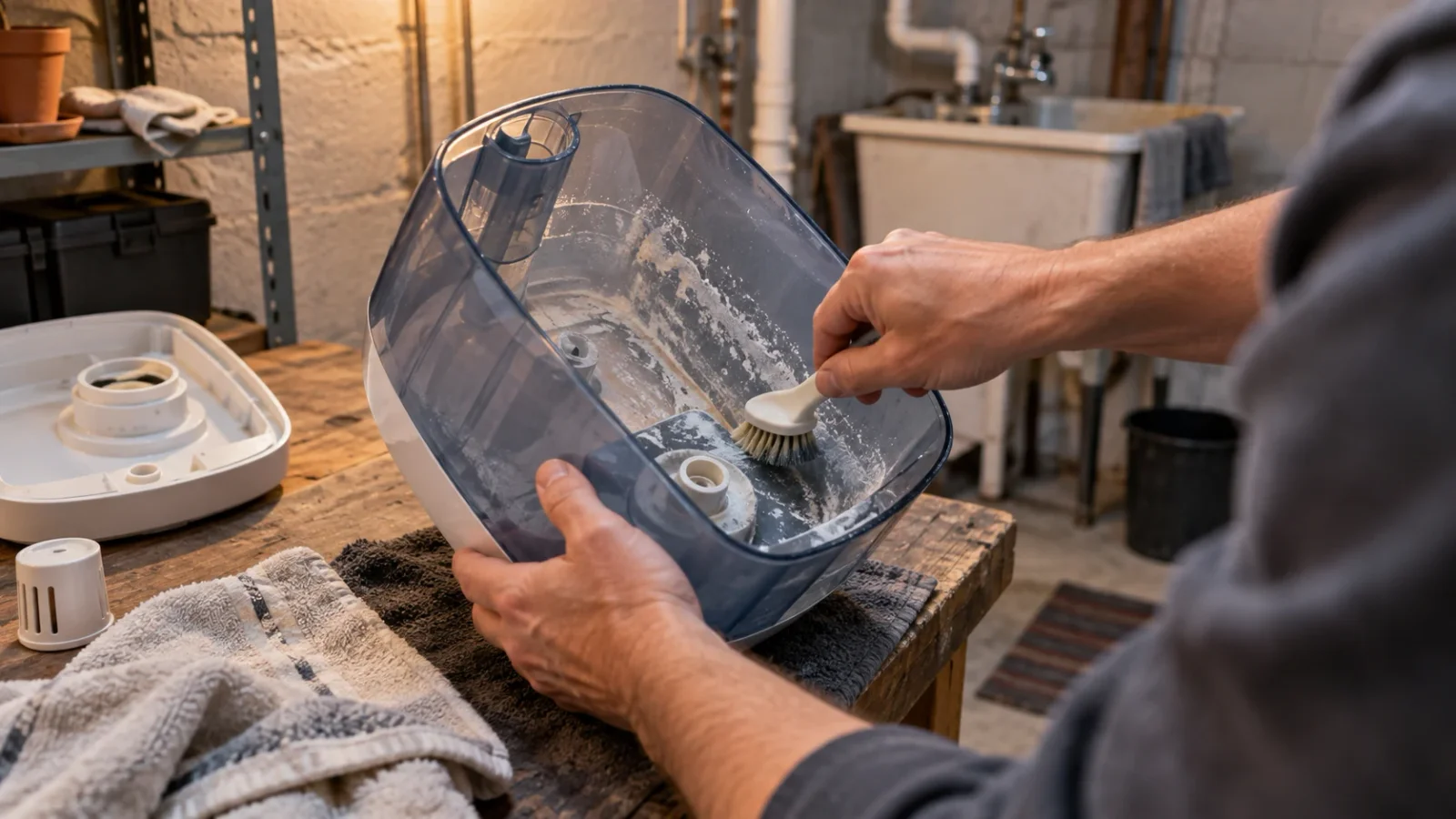
EPA currently advises daily emptying/refill for portable units and cleaning about every third day, with manufacturer instructions taking priority for console or central equipment. Do not wait a full week if the tank is holding standing water.
Fresh water and a clean tank come before humidity targets
| When / trigger | What to do | Why it sits here |
|---|---|---|
| Daily when used | Empty the portable tank, wipe dry, and refill with fresh water | Standing water supports microbial growth. |
| About every third day | Clean scale/film from water-contact surfaces per EPA and manufacturer guidance | Scale can harbor microorganisms and reduce performance. |
| Each refill / as needed | Use lower-mineral water for ultrasonic/impeller units if white dust is a problem | EPA notes distilled water reduces mineral dispersion. |
| Every 3 days for portable units | Empty, scrub and rinse the tank and wet surfaces; follow the manufacturer if it specifies a different method | EPA advises cleaning portable humidifiers about every third day to limit scale and microbial growth. |
| Per filter/wick manual | Replace or rotate wick/filter based on condition, water hardness, and model instructions | Hard water can shorten useful life. |
| End of season | Clean, dry completely, discard spent media, and store dry | Seasonal storage is part of maintenance, not an afterthought. |
Condensation means the setting is too aggressive
- Persistent white dust despite maintenance.
- Musty odor returns quickly.
- Water leaks around the unit.
- Window condensation persists above a conservative humidity setting.
Steam, electrical and respiratory concerns change the response
Steam vaporizers can burn; electrical faults and internal repairs are not cleaning tasks. Stop using a unit that leaks onto electrical surfaces or is associated with concerning respiratory symptoms and follow professional/medical guidance as appropriate.
If the unit is clean and correctly set but still will not humidify, move to fault diagnosis with a humidifier troubleshooting desk.
Hard water changes mineral buildup, not the safe humidity ceiling
Cold climates often need humidification but also have cold window surfaces that condense sooner. Tighter homes may need less added moisture than drafty homes.
Distilled or other low-mineral water can reduce scale and white dust in some portable models, but compare the cost with a compatible demineralization cartridge and the maker’s instructions. If the unit still produces little mist after cleaning and replacing only the consumables the manual identifies, consult the manufacturer or service provider rather than increasing the humidity setting.
Portable humidifier care is more frequent than many owners expect
Unplug the unit before handling the tank or water-contact surfaces. Use only a cleaning product permitted by the manufacturer and rinse thoroughly before operation; residues can be dispersed into room air. At the end of the season, clean, dry, and store the unit as directed, then clean it again before the next use.
Humidity control is the second half of maintenance. EPA advises not exceeding 50% relative humidity with portable humidifiers and generally describes 30%–50% as a useful indoor range. If water condenses on windows, walls or nearby surfaces, reduce output even if the hygrometer number seems acceptable. A damp area around the unit is also a sign to turn it down or use it intermittently. Do not solve low output by continuously increasing humidity when the machine may actually need cleaning, a new consumable or troubleshooting.
- Empty standing water before leaving the unit unused for an extended period.
- Clean and dry the humidifier again before end-of-season storage.
- Stop use and seek appropriate advice if the unit is associated with concerning respiratory symptoms.
Use mineral dust and window condensation as two different warnings
White dust may come from minerals dispersed by some humidifier designs; condensation is evidence that moisture is settling on a surface. Check water type and clean the unit when dust appears, but lower output or use it intermittently when nearby surfaces become damp. A clean tank cannot compensate for a setting the room cannot tolerate.
Keep the unit on a surface that can tolerate incidental moisture and inspect the area around it, not just the tank. A damp wall, swollen trim, wet carpet, recurring odor, or visible growth means the maintenance routine is not controlling moisture. Follow the product instructions for filters, wicks, disinfecting, and water type, because ultrasonic, evaporative, and steam units do not share one service procedure.
| White mineral dust | Persistent condensation | |
|---|---|---|
| What it points to | Minerals in the water and how the unit disperses them | More moisture than the building conditions can handle |
| Response described | Use lower-mineral water if the unit permits it and clean scale as directed | Reduce output even if the hygrometer number seems acceptable |
| Separate check | Check the water type and unit guidance | Watch windows, walls, nearby surfaces, and the area around the unit |
Humidifier-care questions
How often should a portable humidifier be cleaned during heating season?
EPA's current guidance is more frequent than a weekly cleaning habit: empty the tank, wipe surfaces dry and refill portable humidifiers daily, and clean portable units every third day. Always unplug the unit and follow its manufacturer instructions for cleaning products and parts. Console and central humidifiers can have different procedures. If the area around the humidifier becomes damp, reduce output or use and correct the moisture problem rather than simply continuing the same routine.
What indoor humidity range helps avoid over-humidifying the house?
EPA advises not humidifying above 50% relative humidity, and its broader indoor-air guidance commonly places a useful target around 30% to 50%. In cold weather, window condensation can mean the setting is too high for the outdoor temperature even if the room number looks acceptable. Use a hygrometer, watch windows and cool surfaces, and reduce output if condensation or damp materials appear. Comfort should not come at the cost of sustained indoor moisture.
What should I change if white mineral dust keeps returning?
Use low-mineral water such as distilled water when the humidifier type and manufacturer permit it; EPA specifically notes that this can reduce mineral buildup and dispersion. Clean scale on the recommended schedule and replace demineralization cartridges or filters according to the product instructions. Persistent white dust after those changes can indicate the water remains mineral-rich or the unit type is dispersing minerals, so adjust the water source or equipment rather than merely dusting more often.
Portable, console, and central units do not share one service procedure. Follow the maker's directions for filters, wicks, cleaning agents, and water type; unplug before cleaning portable equipment.